Walk into a café in New York, London, or Singapore, and you are almost guaranteed to see “Uji Matcha” somewhere on the menu. From premium lattes to mass-produced confections, the Uji name carries an aura of Japanese authenticity that no other origin can match.
But behind the label is a story most consumers never hear — one of a small place producing far less than the world assumes, a centuries-old blending tradition that shapes the very definition of “Uji Tea,” and a global market now straining under demand that outpaces supply many times over.
This article is not a criticism of anyone. It is a fact-based look at what “Uji Matcha” actually means — its production realities, its legal definition, and the forces shaping the matcha market today.
Uji City: a small place with a towering reputation
Despite its global fame, Uji is a rapidly urbanising city of approximately 180,000 people in southern Kyoto Prefecture. Its agricultural footprint is limited and shrinking — roughly 73 to 78 hectares of tea garden, less than one square kilometre.1
In 2024, the entire Kyoto Prefecture produced approximately 1,648 tons of tencha — the shade-grown, unrolled tea leaves used to make matcha. Of that total, Uji City contributed just 37.6 tons.1
Uji City’s share of tencha production
2024 data
Kyoto Prefecture total
Japan national total
Sources: Kyoto Prefectural Government1, Japanese Senate Research Bureau2
Even within Kyoto Prefecture, Wazuka Town — a quiet mountain community — produces roughly 15 times more tencha than Uji City does.1 Across all of Japan, the numbers tell an even more striking story.
Tencha production at every scale
from a single city to the global market
(largest in Kyoto)
(#1 in Japan)
(2025 projection)
Sources: Kyoto Pref. (2024)1, MAFF / Senate Research Bureau2, China Daily (projection)3
37.6 tons is raw tencha — before stems and veins are removed. The actual volume of finished, stone-ground matcha powder from Uji City soil alone is smaller still. Yet thousands of tons of products labeled “Uji Matcha” circulate worldwide. How?
What “Uji Tea” actually means
The answer lies in the official definition. According to the Kyoto Prefectural Tea Industry Council (京都府茶業会議所), tea does not need to be grown within Uji City to be called “Uji Tea.”4
Under the established definition, tea leaves grown across four prefectures — Kyoto, Nara, Shiga, and Mie — can be legally labeled as Uji Tea, provided they are finished and processed by a vendor within Kyoto Prefecture, with priority given to Kyoto-grown leaves.4
The four prefectures of “Uji Tea”
official definition, established 2004
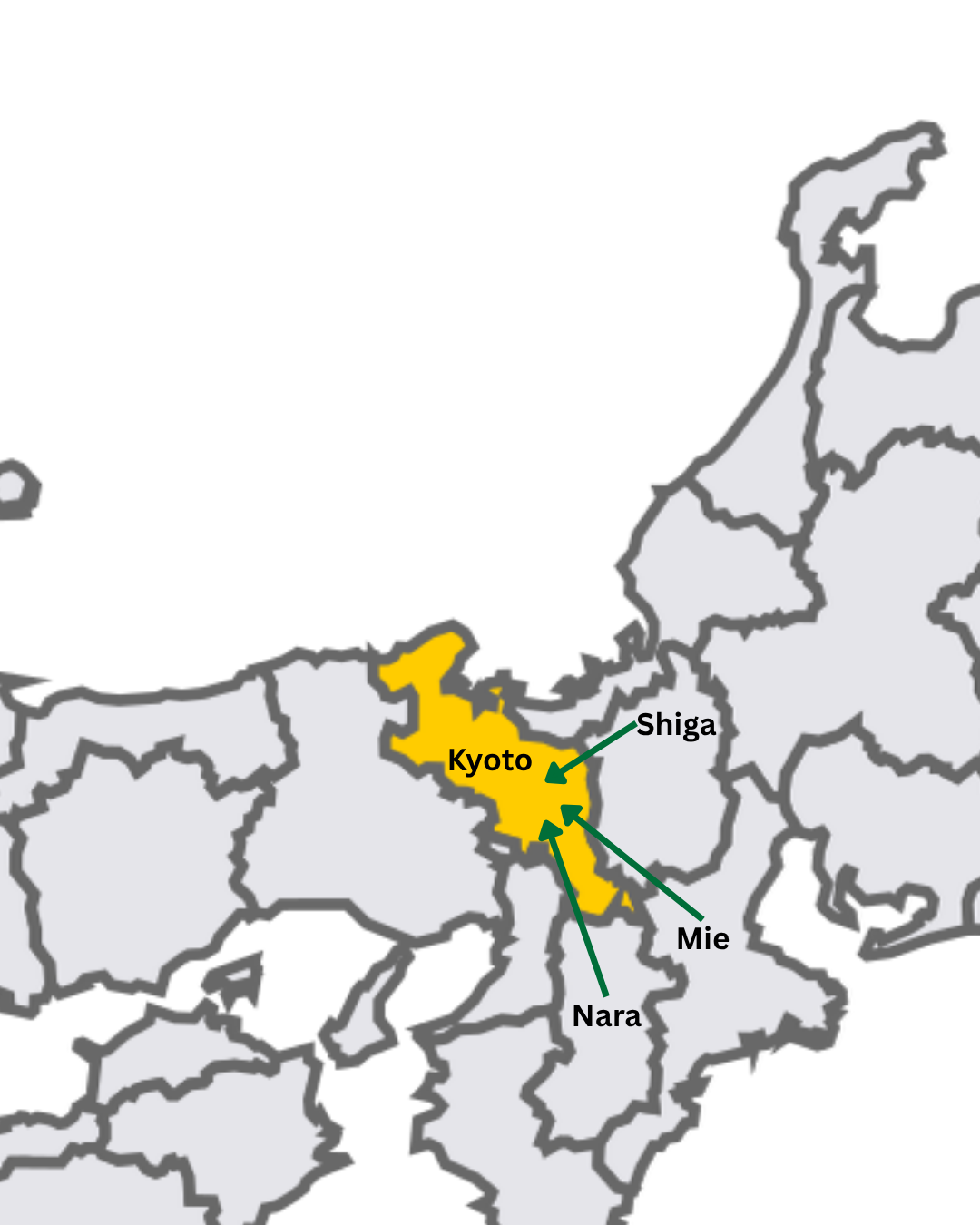
The four highlighted prefectures — Kyoto, Shiga, Mie, and Nara — form the official source region for “Uji Tea.” Leaves grown in any of these prefectures can qualify as Uji Tea when blended and finished by a Kyoto-based vendor.
Source: Kyoto Prefectural Tea Industry Council4
To a modern consumer, this might seem surprising. But historically, it makes sense. For centuries, Uji was the processing and cultural hub of the region. The Uji River basin connects these neighbouring prefectures, and raw tea was traditionally transported along it to Uji’s workshops. The reputation of Uji was never just about its soil — it was about its chashi (tea master blenders) and their generational skill in gogumi (blending). These artisans gathered the best leaves from surrounding provinces and created consistent, refined flavour profiles for the shogun, nobility, and tea ceremony grandmasters.
Sourcing leaves from neighbouring prefectures is not a modern workaround. It is the continuation of a tradition that allows Uji blenders to maintain quality despite the unpredictable nature of weather and harvests.
A market under extraordinary pressure
The global matcha market is experiencing pressures that go far beyond traditional definitions. Japan’s total tencha production hit a record 5,336 tons in 2024 — up from just 1,471 tons in 2010 — and yet, supply still cannot keep up.2 In October 2024, Ippodo suspended matcha sales. Marukyu Koyamaen restricted availability the same month.5
Kyoto first-flush tencha price (¥/kg)
prefectural weighted average, 2019–2025
Sources: Kyoto Prefectural Government1, Japan Tea Central Association (July 2025)6
In 2025, the Kyoto tea market’s opening-day auction average reached ¥8,235/kg — shattering the previous record of ¥4,862/kg from 2016.7 Japan’s 2024 matcha exports totalled 5,092 tons of powdered tea, valued at ¥27.2 billion — up 25.9% year-on-year.8 But the farming population is shrinking. Tea-growing households have declined from 53,687 in 2000 to fewer than 12,000 in 2024.2,5
The global picture
China is now the world’s largest matcha producer by volume, with production projected to exceed 5,000 tons in 2025.3 One important note: China’s national standard (GB/T 34778-2017) requires shade-growing but permits hot-air drying and ball or jet milling — methods that differ from Japan’s traditional approach.9
Because “Uji” lacks strong geographical protection outside Japan, the name has become contested. A 2019 investigation found 163 tea-related trademarks containing “Uji” in China alone, with over 3,000 applications across all product categories.10 Some have been invalidated, but the process remains slow.11
Why traditional matcha cannot scale
If demand is this strong, why can’t Japanese producers simply grow more? The answer is rooted in the nature of the craft itself.
Traditional matcha: from field to powder
Heritage method
the traditional craft
Industrial scale
volume-oriented
A skilled hand-picker can harvest 10 to 15 kilograms of fresh tencha leaves in a day. After processing, approximately 8 to 10 kilograms of fresh leaf yield about 1 kilogram of finished matcha.12
Milling speed: stone mill vs. industrial ball mill
per hour
per hour
Industrial mills process far more volume, but friction heat can degrade colour, aroma, and amino acids.
And the farmers maintaining this craft are aging. Across Japan’s agricultural sector, roughly 70% of core farming workers are over the age of 65.14 The tea industry follows the same trajectory — tea-growing households have dropped by more than 75% since 2000.2
The point of knowing
None of this is meant to discourage anyone from enjoying matcha — from any source. The issue is not that different products exist. It is that when all of them share the same label, it becomes difficult for consumers to understand what they are choosing.
Next time you see a matcha label, consider asking a few questions. What region are the leaves from? What cultivar? What harvest? How was the tea processed? Sellers who know their supply chain tend to share this readily.
At Kawagiri Tea, our starting point is always taste. Every tea we carry has been personally sampled and selected by our founder, Tetsu — a certified Japanese Green Tea Instructor — based on flavour, not on brand names or regional labels alone. We don’t stock a tea because the packaging says “Uji” or because the marketing is convincing. We stock it because we’ve tasted it, and it’s good.
Beyond taste, we believe in transparency. When a customer enjoys a tea and wonders where it came from, we want them to be able to trace it — the cultivar, the farm, the mountain, the harvest season. Not because it makes us look thorough, but because we think that connection matters. When you know where your tea was grown, you start to see past the marketing. You understand matcha a little more honestly. And maybe — even if just for a moment — you think about the person who grew it, tended the shade canopy, picked the leaves, and ground them into the powder that ended up in your cup.
That kind of attention, we believe, is the best thing consumers can offer to the farmers who have spent generations perfecting this craft.
Related reading: Matcha vs Green Tea Powder: What’s the Difference?
References
- Kyoto Prefectural Government: Reiwa 6 (2024) Tea Industry Survey. PDF (Japanese)
- Japanese Senate Research Bureau: “Expansion of Tea Exports — Matcha Supply” (Dec 2025). PDF (Japanese)
- China Daily: “Rural Guizhou county turns big matcha player” (June 2025). chinadaily.com.cn
- Kyoto Prefectural Tea Industry Council: Official definition of Uji Tea. ujicha.or.jp
- Ooika: “11 Facts about the Matcha Shortage.” ooika.co
- Japan Tea Central Association: First-flush tencha bulletin (July 2025). PDF (Japanese)
- Kyoto Shimbun: “Kyoto tea market sets all-time record” (May 2025). kyoto-np.co.jp
- MAFF: “Situation of Tea” (Dec 2025). PDF; Osaka Customs: Green Tea Export Report. PDF
- Best-Matcha: “Global Matcha Production and Quality Differences.” best-matcha.com
- Nihon Shokuryō Shimbun, Dec 13, 2019. nissyoku.co.jp
- Kyoto Shimbun: “‘Kyoto Uji’ trademark invalidated.” kyoto-np.co.jp
- Cha-ology: “From Tencha to Matcha.” cha-ology.com
- Global Japanese Tea Association: “Matcha.” gjtea.org
- MAFF: Agricultural Census / White Paper. maff.go.jp